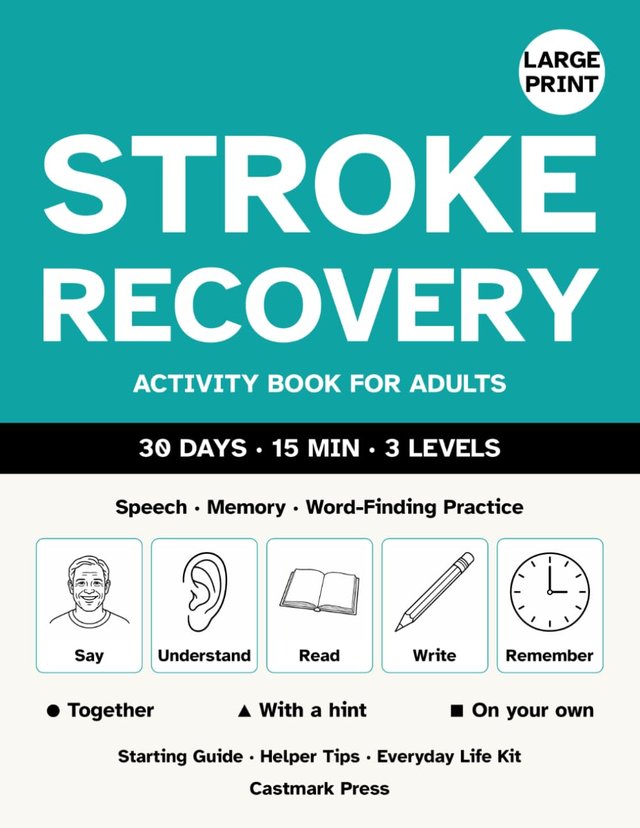
Start with the speech-language pathologist: ask which skills to practice, at what level, and what to avoid. At home, keep sessions short, use adult everyday material, give the lightest hint that works, and do not correct every error. Language and communication can keep improving for many years after a stroke, so steady practice is worth it.
When someone you love comes home from hospital with aphasia, the gap between therapy sessions can feel enormous. You want to help, and the obvious way to help — asking them to name things, correcting their mistakes — is often exactly what makes them stop trying.
This guide is for the family member who sits beside them. It does not replace a speech-language pathologist, and nothing in it is a treatment. It sets out what the major health sources say about aphasia, and a way of practicing at home that keeps it calm, adult and short.
One rule comes before everything else: if you notice any new sign of a stroke — sudden balance loss, vision changes, a drooping face, arm weakness or new trouble speaking — call 911 immediately. Practice can wait.
The speech-language pathologist knows which language skills were affected and how much. Before you practice anything at home, ask four questions: which skills should we practice, what level of difficulty is right today, how much help should I give, and is there anything we should avoid?
Ask how long a session should be and what signs mean it is time to stop. Ask too whether there is homework from therapy you can support. Home practice works best when it repeats what therapy is already doing rather than inventing something new.
Aphasia results from damage to the parts of the brain responsible for language, usually from a stroke or a head injury. The NIDCD estimates that about 2 million people in the United States live with it, and that about a third of stroke survivors are affected (checked 4 October 2026).
It can affect speaking, understanding others, reading and writing. A person may struggle to find a word, use the wrong word, mix up sounds, or lose track of fast speech. ASHA is clear on the point families most need to hear: aphasia does not affect intelligence or how a person thinks.
Recovery differs from person to person. The NIDCD notes that many people improve a great deal in the first few months after the injury, even without treatment, that some aphasia usually remains, and that language and communication abilities can continue to improve for many years.
Keep it short. Ten to fifteen minutes, ending while it is still going well, beats an hour that ends in frustration.
Keep it adult. Use the material of their real life — the calendar, a menu, a bill, the names of family and neighbours — not children's picture books. The Stroke Foundation's advice is to treat the person as an adult, and practice material should do the same.
Give the lightest hint that works. When a word will not come, wait first. Then describe what the thing is used for or where it is found; then give the first sound; then say the word together. Speech therapists call these semantic and phonological cues. Step back to less help as soon as you can.
Do not correct every error. The NIDCD advises against correcting the person's speech. If the meaning is clear, respond to the meaning.
Count any way of communicating as success. Pointing, gesture, drawing and writing a word all count. The aim is to get the message across, not to perform.
The NIDCD's advice for family members is simple and worth taping to the fridge: use short, uncomplicated sentences; keep a natural conversational manner appropriate for an adult; allow plenty of time to talk; avoid correcting their speech; and encourage every form of communication.
Australia's Stroke Foundation adds practical habits: speak clearly and a little more slowly, keep the room calm, ask yes-or-no questions when words are hard, use gestures, drawings and written key words, and never talk about the person as if they were not there.
When you are not sure you understood, check: say back what you think they meant and let them confirm. It shows them they were heard, and it stops a misunderstanding from growing.
This is an example to adapt with the therapist, not a prescription. Each line takes ten to fifteen minutes.
| Day | Skill | Example activity |
|---|---|---|
| Monday | Saying | Name five things on the kitchen table, with hints as needed |
| Tuesday | Understanding | Follow two-step instructions: pick up the cup, then put it by the window |
| Wednesday | Reading | Find the time of a show in the TV listings or on a bus timetable |
| Thursday | Writing | Copy, then write from memory, three names from the family |
| Friday | Remembering | Talk through tomorrow's plan, then recall it an hour later |
| Weekend | Rest or conversation | No exercises — a relaxed chat about a photo or the news |
Stop for the day if the person is tired, upset, or repeating the same error without progress. Ending early is not failure; ending in distress makes the next session harder to start.
Talk to the therapist if practice regularly ends in frustration, if understanding seems to be getting worse, or if you are unsure whether an activity is at the right level.
And call 911 at once for any new sudden sign of stroke. The American Stroke Association uses B.E. F.A.S.T. to remember them: Balance loss, Eye (vision) changes, Face drooping, Arm weakness, Speech difficulty, Time to call 911.
Yes. The NIDCD notes that language and communication abilities can continue to improve for many years after the brain injury, even though the fastest gains usually come in the first few months.
Generally no. The NIDCD advises avoiding correcting the person's speech. If you understood the meaning, respond to it; ask the therapist when correction is useful.
No. ASHA states that aphasia does not affect intelligence or how a person thinks. It affects language — speaking, understanding, reading and writing.
No. Home practice supports therapy; it does not replace it or medical advice. Use it between sessions, at the level the therapist recommends.
Rules change. Where a figure or a procedure can move, the issuing agency’s current published instructions win over anything here.