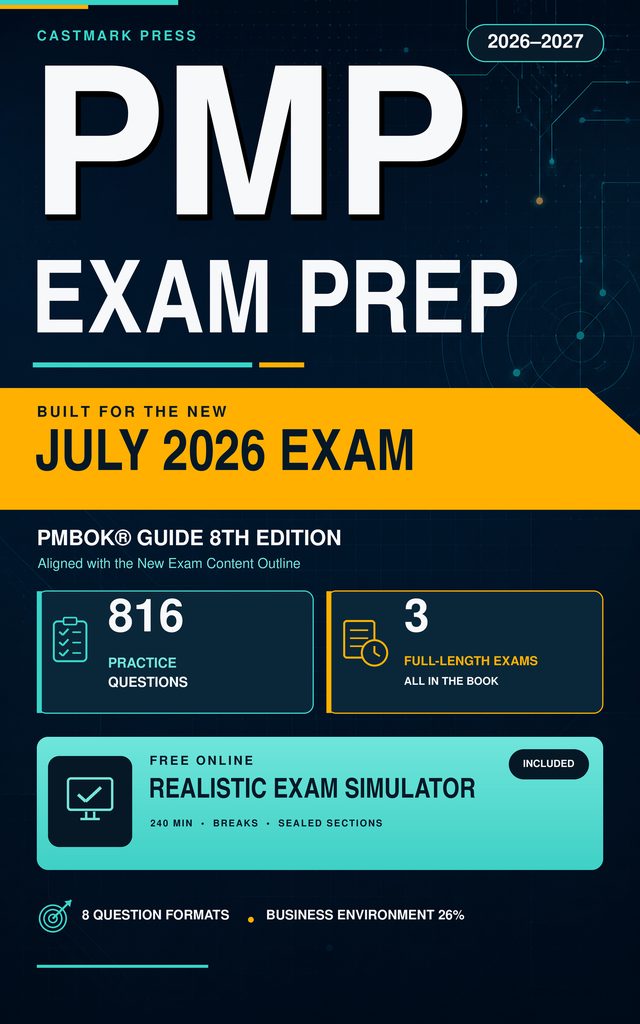
Since 9 July 2026, every PMP sitting uses a reorganized exam content outline. AI and sustainability are in scope, and two item types are new: case or scenario sets and graphic-based questions. People, Process, and Business Environment survive, weighted 33%, 41% and 26% on the outline. PMBOK 8 is one of ten cited sources, not the exam's basis.
On 9 July 2026, the PMP exam changed. Every sitting since that date is written against a new exam content outline; PMI lists the PMBOK Guide as one of the ten sources its question writers cite most often, and names no single text or edition as the exam's basis. Whatever your test date now, the study material you choose has to be built for the new outline — not patched from an older edition.
This guide covers what actually changed, what stayed familiar, and the honest answer to the question most candidates ask: do I have to start over?
Four things matter. First, the exam content outline itself: the tasks the exam is allowed to test are reorganized, and the outline is what the exam is built from. Second, the reference shelf moves on: the current PMBOK Guide is the Eighth Edition, which PMI says keeps the Seventh Edition's principles and performance domains while simplifying them — and which PMI lists as one of ten cited sources, not as what the exam is written against.
Third, topics that were at the margins move into scope: the outline brings AI in project work and sustainability considerations into the set of things a question can legitimately ask about.
Fourth — and this is the one candidates feel on exam day — new question formats. PMI's outline marks two item types as new: case or scenario sets, where several questions hang off one longer scenario, and graphic-based questions, where the item starts from a chart, graph, diagram or image rather than a paragraph. They join the formats already in use. We wrote a separate guide on how to handle both.
The three domains survive: People, Process, and Business Environment still organize the outline, and the exam still tests judgment in context rather than recall of definitions. It is not one unbroken stretch, though — PMI describes 180 questions in 240 minutes, split by two 10-minute breaks, with a case-study section that closes before the first break. Agile, hybrid and predictive approaches all stay in scope — the question is still "what should the project manager do next", asked about situations rather than glossary terms.
Our practice tests mirror that shape: three full-length, 180-question papers, weighted like the exam's published domain percentages, with every option explained.
No — but you do have to translate. If you studied with PMBOK 7-era material, most of what you know is still true; it is organized and named differently. Relearning from zero wastes weeks. Studying from old material without a map wastes points.
That is why our guide includes old-to-new translation tables: they show what moved, what was renamed, and what is genuinely new, so PMBOK 7-era notes become an asset instead of a liability.
Work from the outline, not the reference. Diagnose where you stand, drill task by task across the three domains, learn the two new question formats deliberately, and finish with full-length timed sittings — not question snacking.
If you have about a month, our 30-day plan sequences exactly that, and the book's free companion app drills the book's own questions, scores you by outline task, and tells you which chapter to reopen. If you have longer, the same sequence stretches; the order is what matters.
One caution that applies to every exam we publish for: the issuing organization's current instructions always win. Check PMI's official pages for your application, scheduling and test-day rules — a study guide is for the material, not the paperwork.
Exam sittings from 9 July 2026 onward use the new exam content outline, which PMI says is not written according to any single text or supported by any specific reference. That date has now passed, so every PMP sitting uses this outline.
Yes — since 9 July 2026 every PMP sitting has used the new outline. This book is written for the exam that began on 9 July 2026. If your notes date from before the change, keep them and work from the new outline rather than starting over.
The PMBOK is the reference, not the exam. The exam is written against the content outline, and it tests judgment in scenarios. You need material organized around the outline's tasks, with practice questions that explain why the wrong answers are wrong.
PMI publishes percentages only at the domain level — People 33%, Process 41%, Business Environment 26% on the front of the July 2026 outline — and none for individual topics like AI or sustainability, so we will not invent them. What is true: the new outline puts these topics in scope, questions can ask about them, and our guide covers them where they sit in the outline.
Rules change. Where a figure or a procedure can move, the issuing agency’s current published instructions win over anything here.