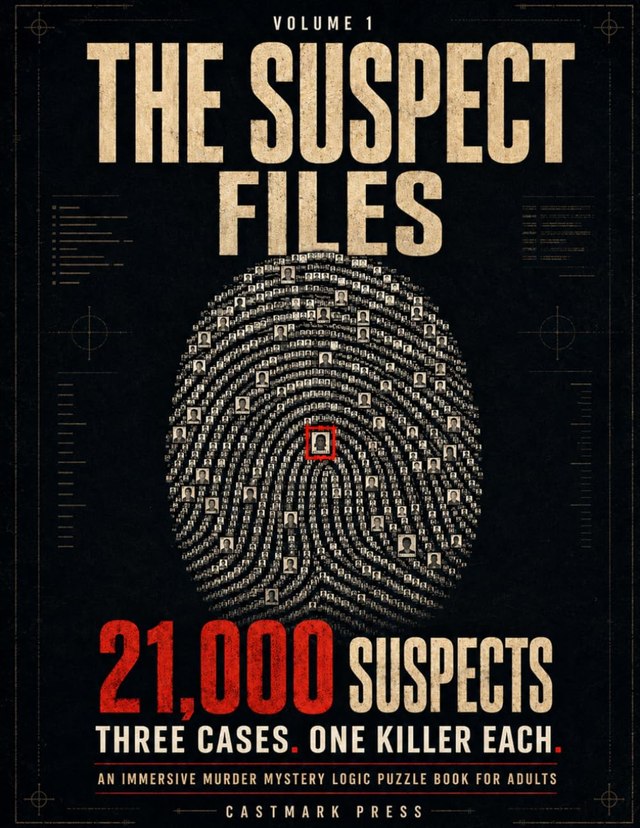
Read every clue before marking anything, rank them by how much they cut against how long they take, and work the cheap heavy ones first. Then one pass per clue, in a fixed direction, in pencil, finishing each pass before starting the next. Crossing out someone who should have stayed is the only fatal error.
An elimination puzzle looks impossible the first time you open one. Fifteen thousand faces on a wall of portraits, a handful of clues, and one killer somewhere in there. The reflex is to start at clue one and start crossing out.
That reflex is the reason people stall. Elimination puzzles reward a method that has almost nothing in common with the one logic grids teach, and the method is learnable in about five minutes. This guide is that method.
A logic grid gives you a small set of items and asks you to build the answer: you infer, you fill cells, and the solution assembles itself. Elimination works the other way round. You are handed a population and a set of clues that each remove part of it, and you are not building an answer at all — you are removing everything that is not the answer.
That inversion changes what skill matters. A grid rewards inference. An elimination puzzle rewards order of operations. The deductions themselves are usually trivial; the difficulty is entirely in doing thousands of them without losing your place.
The single most expensive mistake is starting at clue one. Clues differ enormously in how much they cut and in how long they take to apply, and those two things are not related.
A clue that removes everyone not wearing glasses might take out half the wall in a single sweep. A clue about a scar on the left cheek might remove forty people and take you twenty minutes of squinting. Applied in the wrong order, you do the twenty minutes of squinting on people who were going to be eliminated anyway.
So read all of them first, rank them roughly by how much they cut against how long they take, and work the cheap heavy ones first. On a large case this alone can halve the evening.
Pencil, and a single clean stroke. You will want to re-check something later, and a scribbled-out face is a face you can no longer read.
One pass per clue, and finish the pass. Sweep the wall in a fixed order — left to right, top to bottom — applying one clue and only that clue, all the way to the end before you pick up the next. Switching clues mid-pass is how survivors get missed, and a missed survivor does not announce itself; you simply arrive at the end with two suspects standing and no idea which pass went wrong.
If you have to stop mid-pass, write down which clue you were on and where you stopped. Coming back to a half-applied clue with no note is the most common way an evening's work becomes unusable.
Physical clues are applied by scanning — you are pattern-matching across a wall, and your eye does most of the work. Name clues are applied by reading, which is a different mode entirely and uses a different kind of attention.
Batching them helps more than it sounds like it should. Do the face clues in one session and the name clues in another. What tires you on a long case is not the volume; it is switching between looking and reading every few minutes.
It also changes where errors come from. Face-clue errors are usually misses — you skimmed a row. Name-clue errors are usually misreadings — you applied a stricter rule than the clue actually stated.
When a case will not resolve, it is almost always one of three things. A clue was misread. A pass was abandoned halfway. Or a clue was applied more strictly than it was written.
The third is the sneaky one. Wearing a hat is not wearing a cap. Seen near the theatre is not seen inside it. Reread the clue absolutely literally, word by word, before assuming the puzzle is broken — puzzles of this kind are built so that the literal reading is always the correct one.
And if that does not do it, take the smallest amount of help available rather than abandoning the case. A hint ladder exists so you can take the first rung without seeing the third — a nudge about which clue to revisit is a different thing from being told the answer, and it is usually all that is needed.
Evenings, not minutes — and the scale is the point. A thousand suspects is an evening. Fifteen thousand is a project you come back to, which is why the cases are ordered by size rather than shuffled.
Neither. This is pure deduction: no arithmetic, no general knowledge, nothing you need to have read beforehand. Everything required to solve a case is printed inside it.
Elimination is forgiving in exactly one direction. Leaving someone in who should have gone costs you nothing — a later clue removes them. Crossing out someone who should have stayed is the error that ends the case, which is the whole reason for marking once, in pencil, one clue at a time.
Yes, and there is a right way to split it: divide the wall, not the clues. Each person takes a region and applies every clue to it. Splitting by clue means two people marking the same faces, and it goes wrong quickly.
No. Everything is in the book — the portraits, the registers, the clues, the hint ladder, and solutions sealed in mirror text so you cannot read one by accident.