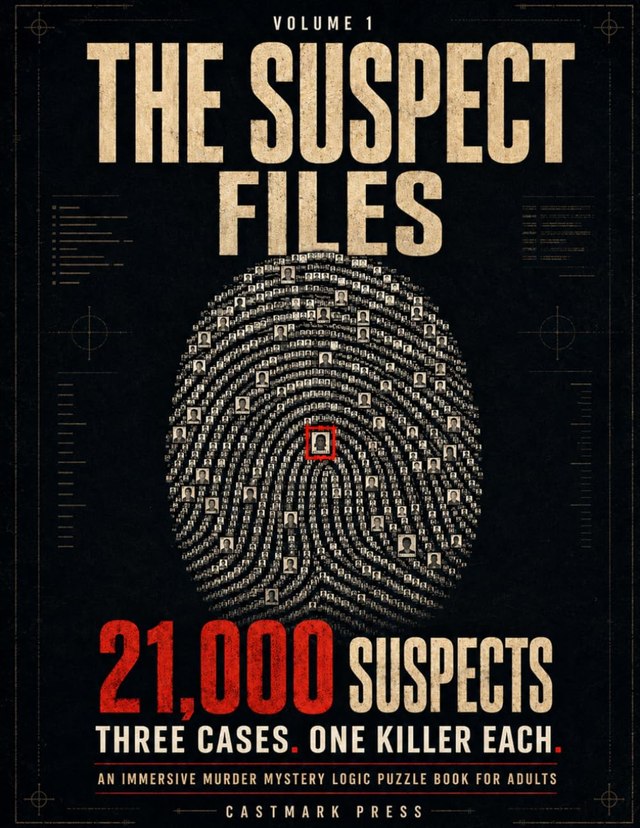
The problem is rarely difficulty — it is duration. Someone who finishes a book of short puzzles in one sitting wants something with scale: one puzzle that runs for an evening or more, where the challenge is sustained deduction rather than a hundred separate three-minute problems. Look for size, not for a harder version of the same thing.
You are buying for someone who is good at this. They have done the crosswords, the sudoku, the logic grids and the escape-room-in-a-box, and every one of them was finished faster than you expected and then set down.
The instinct at that point is to look for something harder. It is usually the wrong instinct, and it is why the last three gifts did not land. The problem was not that the puzzles were too easy. It was that each one ended after four minutes and the book was a hundred of them.
What that person is missing is duration. This guide covers the difference between difficulty and scale, why it changes the whole experience, and the questions that let you buy accurately for someone whose taste you only partly know.
A hard sudoku and an easy sudoku take different amounts of time, but they are the same kind of experience: a self-contained problem with a start, a middle and an end inside one sitting. Making it harder makes it longer by minutes.
Some puzzles work on a completely different axis. They are not harder in the sense of requiring cleverer insight; they are larger. The deduction at any given moment may be straightforward, and there is a great deal of it, arranged so that the whole holds together and produces a single answer at the end.
That produces a different pleasure, and it is the one the person you are buying for is probably missing. You put it down at eleven and pick it up on Thursday. Progress accumulates. The end is earned rather than arrived at.
So when you find yourself looking for "expert level" or "fiendish", pause and consider whether the person actually wants something that takes longer rather than something that requires more.
Three things change once a puzzle is large enough that it cannot be finished in a sitting.
Method starts to matter. In a short puzzle you can hold everything in your head and improvise. In a large one you cannot, so you develop an approach — an order of operations, a way of marking, a way of resuming after a break. Solvers who like this genuinely enjoy that layer, and it does not exist at small scale.
The stakes of an error change. In a five-minute puzzle a mistake costs five minutes. In an evening-long one it costs the evening, which makes care meaningful rather than pedantic — and makes finishing feel like something you did rather than something that happened.
And it becomes an occupation rather than a diversion. Something to return to across a week, thought about in between. That is a different relationship with a book, and it is why the person who devours a hundred short puzzles in an afternoon can be genuinely absorbed by one large one for a fortnight.
The word puzzle covers several unrelated pleasures, and the mismatch between them is the most common way a gift misses.
| If they like | They enjoy | Avoid buying them |
|---|---|---|
| Crosswords | Vocabulary, wordplay, general knowledge | Pure logic with no language in it |
| Sudoku and its variants | Constraint satisfaction, patterns, no language at all | Anything requiring trivia or reading |
| Logic grids | Inference from clues, building an answer up | Anything mostly about speed |
| Escape rooms and puzzle hunts | Variety, narrative, being surprised | A hundred of the same puzzle type |
| Jigsaws | Long, calm, physical, resumable | Anything with a ticking timer |
| Deduction with scale | One long problem, method, an earned ending | Books of short puzzles, however hard |
This is worth understanding before buying, because the two look similar and feel completely different.
A logic grid gives you a small set of items and a set of clues, and you build the answer: you infer, you fill in cells, and the solution assembles itself. It is a construction task.
An elimination puzzle gives you a large population and clues that each remove part of it. You are not building an answer at all — you are removing everything that is not the answer, until one candidate is left standing.
That inversion is what allows scale. A logic grid with fifteen thousand items would be unusable; an elimination puzzle with fifteen thousand suspects is simply a long one, because each clue does bulk work. It also changes which skill is rewarded: a grid rewards inference, an elimination puzzle rewards order of operations and care.
If the person you are buying for likes the moment when a deduction clicks, a grid delivers that more often. If they like sustained absorption and the feeling of a field narrowing under their hand, elimination is the one.
Does it need anything besides the book. Anything requiring an app, a code, a website or a subscription can expire, and it excludes anyone who wanted a screen-free evening in the first place. Self-contained is worth paying for.
How the answers are handled. A solutions section that can be glimpsed while flicking through spoils a long puzzle instantly. Sealed, reversed or mirrored solutions exist precisely because a puzzle you have spent a week on deserves not to be ruined by a page turn.
Whether there is a way to get unstuck that is not the answer. Graduated hints — a nudge toward which clue to revisit, rather than the solution — are what separate a book someone finishes from a book someone abandons at the difficult point.
Format and print size, which sound trivial and are not. A large-format book that lies flat, with print you can read under a lamp at ten at night, is a genuinely different object from a paperback that has to be held open.
And whether it stands alone. If the puzzle has a difficulty progression — a smaller case, then a larger, then a large one — the buyer gets a gift that works for a beginner and a veteran, and the recipient gets somewhere to start.
Something with scale rather than something harder. One long puzzle that runs across several evenings is a different experience from a hundred short ones, and it is usually the thing they are actually missing.
A grid asks you to build the answer from clues. An elimination puzzle hands you a large population and clues that remove parts of it, until one candidate remains. The inversion is what lets elimination puzzles work at very large scale.
Good ones do not. Pure deduction puzzles contain everything needed to solve them, which also makes them safe to buy for someone whose knowledge of any particular subject you cannot predict.
Look for graduated hints — a nudge about which clue to revisit rather than the answer. A book with only a solutions section gives a stuck solver a choice between quitting and spoiling it.
For someone who finishes ordinary puzzle books in a sitting, look for something measured in evenings rather than minutes. A puzzle you put down and return to on Thursday is the experience they are missing.